


Student Code of Conduct
The Student Code of Conduct establishes boundaries of acceptable behaviour for students and trainees of Tavistock Education and Training (TET), part of North London NHS Foundation Trust (NLFT). Students and trainees are expected to adhere to the standards of behaviour which are set out in this document.
Student Code of Conduct
1. Introduction
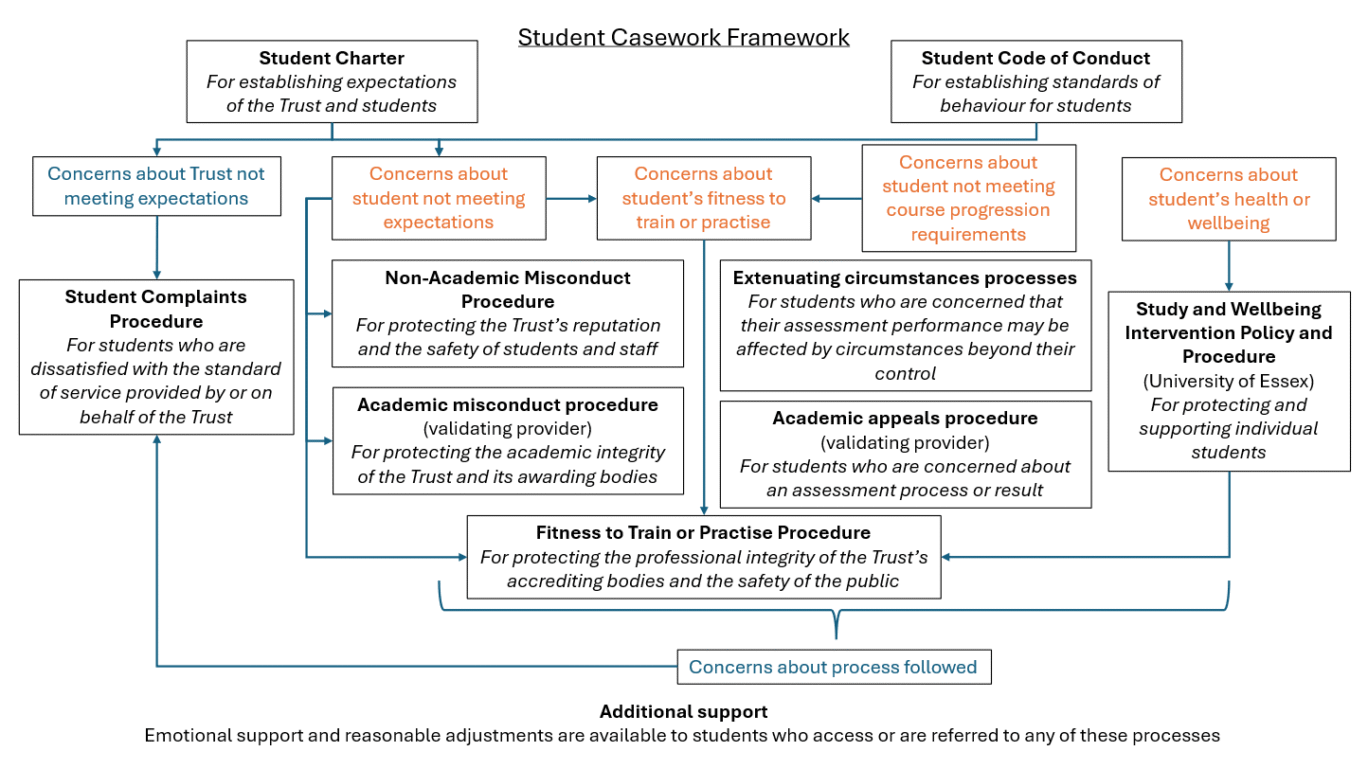
Tavistock Education and Training (TET), part of North London NHS Foundation Trust (NLFT), operates four mechanisms which set out the various expectations which apply to its students and trainees:
- Terms and Conditions: Students are expected to comply with the terms and conditions of study which they agree to when completing their enrolment.
- Trust Values: Students are expected to behave in a manner which is consistent with North London NHS Foundation Trust’s values.
- Student Charter: Students are expected to understand TET’s vision and mission and adhere to the ethos of its education and training courses. The charter is a two-way document which also sets out what students should expect of TET.
- Student Code of Conduct: Students are expected to adhere to the standards of behaviour which are set out in this document. The code of conduct establishes boundaries of acceptable behaviour for students.
TET also operates the following procedures which students may be referred to if their behaviour does not meet TET’s expectations:
- Study and Wellbeing Intervention Policy and Procedure
- Non-Academic Misconduct Procedure
- Fitness to Train or Practise Procedure
2. Higher education providers and professional bodies
Many of TET’s education and training courses are validated by its university partners, including the University of Essex and the University of East London, and NLFT is registered with the Office for Students, which is the regulator for higher education in England.
Consequently, this code of conduct is informed by the standards of behaviour set out by the Office of the Independent Adjudicator for Higher Education in its Good Practice Framework and by its university partners in their student codes of conduct.
Additionally, many of TET’s courses are accredited by external professional bodies, including the Association of Child Psychotherapists, the Association for Family Therapy and Systemic Practice in the UK and the British Psychoanalytic Council, and TET also delivers Continuing Professional Development courses.
Consequently, this code of conduct is also informed by the standards of behaviour set out by the Professional Standards Authority for Health and Social Care and the relevant professional bodies in their codes of conduct and ethics.
3. Standards of behaviour
a. Complying with the law
Students must act within the law and must not engage in any behaviour which may constitute a criminal offence. Some examples of prohibited behaviour include violent crimes such as assault and financial crimes such as bribery.
b. Promoting a positive learning environment
Students must take care to promote a positive learning environment both in person and online and must not engage in any behaviour which impedes the activities or services of TET, NLFT, or any national centres. Some examples of prohibited behaviour include disrupting a lecture and preventing another student from attending a lecture.
c. Promoting equality, diversity and inclusion
Students must take care to promote an inclusive learning environment where everyone can benefit equally from TET’s learning and development opportunities.
TET operates a zero-tolerance approach to discrimination and victimisation, and students must not engage in any behaviour which discriminates against or victimises another person.
This applies to behaviour towards other students, staff, patients, and any visitors to TET, NLFT, or any national centres. It also applies to online as well as in-person behaviour.
In line with the Equality Act 2010, prohibited behaviour includes any behaviour which treats a person less favourably than others because of a protected characteristic or because they have raised concerns about injustice.
d. Tackling bullying, harassment and sexual misconduct
Students must take care to promote a learning environment which is safe and free from bullying, harassment and sexual misconduct.
TET operates a zero-tolerance approach to bulling, harassment and sexual misconduct and students must not engage in any behaviour which bullies or harasses another person.
This applies to behaviour towards other students, staff, patients, and any visitors to TET, NLFT, or any national centres. It also applies to online as well as in-person behaviour.
In line with the Equality Act 2010, prohibited behaviour includes any unwanted behaviour which has the purpose or effect of violating another person’s dignity or creating an intimidating, hostile, degrading, humiliating or offensive environment for them.
e. Protecting health, safety and wellbeing
Students must take care to protect the health, safety and wellbeing of other students, staff, patients, and any visitors to TET, NLFT, or any national centres. Students must not engage in any behaviour either in person or online which may cause a health and safety issue.
Some examples of prohibited behaviour include possessing a weapon on any premises of TET, NLFT, or any national centres and failing to evacuate these premises when a fire alarm sounds.
f. Maintaining honesty and integrity
Students must take care to maintain honesty and integrity. This includes engaging appropriately with TET’s processes and information requests and not providing false information.
This applies to academic integrity and professional candour as well as other types of behaviour. Students must behave with honesty and integrity in relation to their academic and clinical work. Students who attempt to gain an unfair advantage in any formal assessment will be referred to the relevant university partner’s academic conduct procedures.
Some examples of prohibited behaviour include falsely recording attendance at a lecture and falsifying evidence for an extenuating circumstances claim.
g. Accessing and sharing information appropriately
Students must adhere to TET’s policies around the acceptable use of information systems and treat confidential information carefully.
Some examples of prohibited behaviour include posting obscene content in the virtual learning environment and attempting to hack into another student’s account.
h. Preserving the work and reputation of TET
Students play a key role in helping to quality assure the activities and services of TET, NLFT, or any national centres, and in safeguarding their reputations. Students must not engage in any behaviour which may harm these reputations or TET’s relationships with other organisations (this does not include whistleblowing).
Some examples of prohibited behaviour include damaging property which belongs to TET, NLFT, or any national centres and publishing negative information about these organisations.
4. Appendix A: Student Casework Framework