


Fitness to Train or Practise Procedure
The purpose of this procedure is to ensure that any concerns about the fitness to train or practise of students or trainees of Tavistock Education and Training (TET), part of North London NHS Foundation Trust (NLFT), can be addressed appropriately.
Fitness to Train or Practise Procedure
1. Introduction
The purpose of this procedure is to ensure that any concerns about the fitness to train or practise of students or trainees of Tavistock Education and Training (TET), part of North London NHS Foundation Trust (NLFT), can be addressed appropriately.
2. Principles
This procedure is informed by the principles set out by the Office of the Independent Adjudicator for Higher Education (OIAHE) in its Good Practice Framework: Fitness to Practise (October 2019).
Therefore, the procedure aims to be:
- Accessible and clear,
- Flexible, proportionate and timely,
- Fair and independent,
- Transparent and confidential as appropriate.
And the procedure is committed to:
- Following the principles of natural justice,
- Treating everyone involved in any case with dignity and respect,
- Considering the wellbeing of everyone involved in any case,
- Resolving issues at the earliest opportunity,
- Promoting positive behaviours and improving the student experience.
3. Duties and responsibilities
The implementation of this procedure is the responsibility of TET and is overseen by the Chief Education and Training Officer/Dean of Postgraduate Studies.
Although it is intended that the named post holders will undertake the duties and responsibilities outlined in this procedure, there may occasionally be instances where one or more members of staff who would normally handle a referral are unavailable or have a conflict of interest. In such instances, TET will appoint an appropriate nominee to replace them.
4. Advice and support
Students are encouraged to seek advice from the Student Complaints, Conduct and Appeals Officer in relation to this procedure.
The Student Complaints, Conduct and Appeals Officer can provide advice on:
- Reasonable adjustments while using the procedure,
- Other support available while using the procedure, such as wellbeing support,
- Other procedures which it may be appropriate for students to access.
Students should email StudentCasework@Tavi-Port.nhs.uk.
5. Scope
a. Causes of fitness to train or practise concerns
TET has a responsibility for assuring that students on all its courses are fit to complete their training safely and effectively. TET also has a responsibility for assuring that students on its professional courses are fit to practise their professions safely and effectively.
Any student of TET on a course which leads to a professional accreditation may be referred to this procedure. TET will refer to fitness to practise guidelines issued by the relevant professional bodies and may liaise with them to determine how the concerns should be addressed.
There is not an exhaustive list of causes of fitness to train or practise concerns.
Examples may include:
- Academic or non-academic misconduct, including behaviour which contravenes NLFT’s values, the Student Charter or the Student Code of Conduct (in such instances, students may also be referred to the relevant university partner’s academic conduct procedures or the Non-Academic Misconduct Procedure),
- Mental or physical health difficulties or serious physical impairment that interferes with the student’s ability to train or practise safely, or failure to seek or engage with support for these circumstances (in such instances, students may also be referred to the University of Essex’s Study and Wellbeing Intervention Policy and Procedure),
- Breaches of relevant professional bodies’ codes of conduct or ethics,
- Breaches of health and safety standards,
- Unsafe practice or incompetence,
- Lack of development according to expected academic and professional standards,
- Breaking patient confidentiality,
- Safeguarding concerns,
- Poor communication or language skills.
b. Health and disability issues
Fitness to train or practise concerns may be related to the student’s mental or physical health, or to a disability.
In such instances, TET will consider:
- Its obligations under the relevant equalities legislation,
- Any applicable competence standards (defined in the Equality Act 2010 as: “An academic, medical or other standard applied for the purpose of determining whether a person has a particular level of competence or ability.”).
c. Placement providers and professional bodies
Fitness to train or practise concerns may arise during the student’s placement.
In such instances, TET will normally inform the student’s placement provider that they have been referred to this procedure and of the outcome.
TET may liaise with the placement provider to determine how the concerns should be addressed and will normally conduct its own investigation into the concerns which may involve placement staff.
If appropriate, TET will inform the relevant professional bodies that a student has been referred to this procedure and of the outcome.
d. Cases which require immediate action
TET may deviate from the stages set out below if particularly swift action is required.
There is not an exhaustive list of such instances.
Examples may include:
- The case involves a threat of serious harm or disruption to the student, others or Trust activities,
- The student’s mental health is at risk, or they have displayed significant distress,
- The issues are highly sensitive.
In such instances, TET may take appropriate precautionary measures while a full investigation is completed, including:
- Limiting access to Trust or other relevant premises, grounds, facilities or services,
- Limiting contact with patients,
- Imposing a period of temporary suspension from the student’s course or placement.
Taking a precautionary measure does not indicate that TET has concluded that the student is not fit to train or practise.
If a precautionary measure is taken, it will be reviewed periodically as the investigation progresses. If the investigation overruns, it may be necessary to extend the precautionary measure.
If TET decides that a precautionary measure should be taken or extended, it will notify the student of this and provide an explanation. The student will have the opportunity to appeal this decision. If an appeal of this kind is not upheld, TET will issue a Completion of Procedures Letter which the student may take to the OIAHE or appropriate external organisation.
e. Behaviour which may constitute a criminal offence
TET will provide appropriate and relevant information and support to students who are involved in raising or responding to concerns about behaviour which may constitute a criminal offence without putting pressure on them to take a particular course of action.
In exceptional circumstances, TET may report an alleged crime to the police itself (for example, where TET, NLFT, or a national centre is the victim of the crime or where this is necessary to protect someone from harm or to prevent a further crime taking place).
If an external organisation, such as the police or courts, become involved in addressing concerns about a student’s behaviour, TET will normally suspend this procedure until the external processes have been completed but may take appropriate precautionary measures while they are ongoing.
6. Burden and standard of proof
In fitness to train or practise cases, the burden of proof is on TET. This means that TET must prove that the student has done what they are accused of doing, using evidence and explaining how the incident or behaviour impairs the student’s fitness to train or practise.
If the student subsequently wishes to dispute the allegation, they must rebut it using evidence, including of any mitigating circumstances or factors that they wish to rely on.
TET will use the standard of proof which is normally used in civil cases, and which is mandated for use in fitness to practise procedures by section 112 of the Health and Social Care Act 2008: the balance of probabilities. This means that the evidence must show that it is more likely than not that the student has done what they are accused of doing.
7. Referrals
a. Initial stage
i. Acknowledging the concerns
TET is committed to adopting a developmental and supportive approach when addressing fitness to train or practise concerns.
Therefore, course teams are encouraged to address concerns directly with students unless the concerns are sufficiently serious to warrant escalation to the formal stage straight away. If a member of staff is unsure whether the concerns should be escalated to the formal stage straight away, they should contact the Student Complaints, Conduct and Appeals Officer.
Minor fitness to train or practise concerns should be reported to the Course Lead who will discuss them with the Head of Portfolio and keep a record of this discussion.
The Course Lead will notify the student of the concerns, normally within five working days, and provide any available supporting evidence. They will then arrange to meet with the student to address the concerns.
The student will be given at least five working days to prepare for the meeting and may be accompanied at the meeting, normally by a fellow student or member of Trust staff.
ii. Addressing the concerns
The meeting will establish whether supportive improvement measures are required for the student.
If supportive improvement measures are not required, this will be agreed with the Head of Portfolio and confirmed in writing to the student, normally within five working days, and they will be told whether TET intends to keep a record of the concerns.
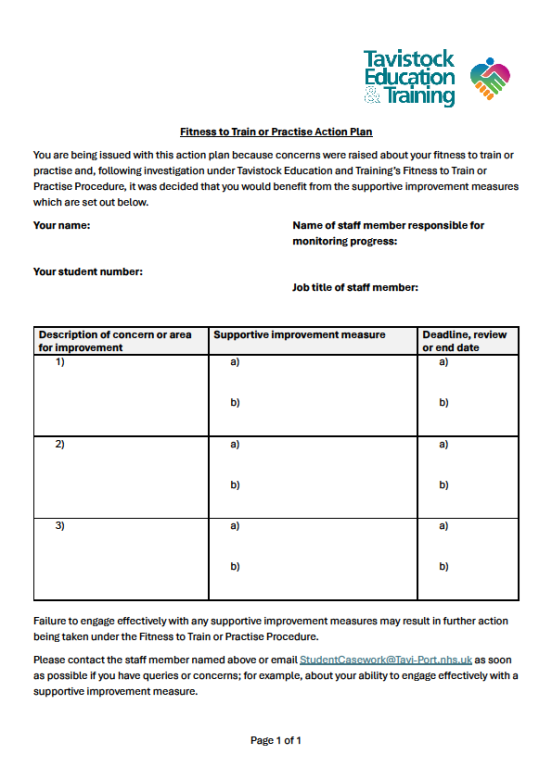
If supportive improvement measures are required, they will be agreed with the Head of Portfolio and set out in a fitness to train or practise action plan (Appendix C). The action plan will be shared with the student, normally within five working days, and include timescales and next steps for monitoring improvement.
TET will keep the student updated in case of any delays at this stage of the process.
At the end of this stage of the process, the Course Lead will notify the Student Complaints, Conduct and Appeals Officer of the referral and, if applicable, share a copy of the action plan.
iii. Escalating the concerns
There may be instances where TET attempts to address concerns at the initial stage of this procedure but subsequently needs to escalate them to the formal stage.
Such instances are likely to include:
- Cases where the student has been given a reasonable opportunity to attend a meeting or otherwise engage with the initial stage and has not done so,
- Cases where the student refuses to engage with any supportive improvement measures,
- Cases where a fitness to train or practise action plan has been implemented but the student has failed to make the necessary improvement within the timescales.
b. Formal stage
i. Acknowledging the concerns
Major fitness to train or practise concerns should be reported to the Student Complaints, Conduct and Appeals Officer. This is likely to include concerns about students who have already completed the initial stage of this procedure or been investigated under a different procedure.
The Student Complaints, Conduct and Appeals Officer will notify the student of the concerns, normally within five working days, and provide any available supporting evidence.
TET will appoint an independent Adjudicator with relevant expertise in the subject matter to address the concerns. This person will normally be a Head of Portfolio or other senior member of staff.
If the facts of the case have already been established, for example through a disciplinary panel hearing under the Non-Academic Misconduct Procedure, the Adjudicator will not normally need to make any enquiries.
If the facts of the case have not already been established, the Adjudicator will need to make enquiries to try to establish the validity and severity of the concerns.
Regardless of whether the facts of the case have already been established, the Adjudicator will discuss them with the Academic Governance and Quality Assurance Office and keep a record of this discussion. The Adjudicator will then arrange to meet with the student in liaison with the Student Complaints, Conduct and Appeals Officer.
The student will be given at least five working days to prepare for the meeting and will be provided with copies of any documentation which the Adjudicator will consider. The student may be accompanied at the meeting, normally by a fellow student or member of Trust staff.
The Student Complaints, Conduct and Appeals Officer will attend the meeting and any others which are arranged as part of the investigatory process to answer any questions about the procedure and take notes. Meeting notes will be shared with all attendees, and they will have the opportunity to propose any amendments.
If the student has been given a reasonable opportunity to confirm their attendance or meet with the Adjudicator and has not engaged with the process, TET will continue to address the concerns in line with this procedure and may convene a fitness to train or practise panel hearing.
ii. Addressing the concerns
Once they have met with the student and gathered sufficient information and evidence, the Adjudicator will compile an evaluation report which details the action taken and their findings.
The report will be shared with the Student Complaints, Conduct and Appeals Officer and the Director of Education, Governance and Quality in the first instance.
The report will normally recommend one of the following:
- The concerns should be dismissed,
- Supportive improvement measures are required for the student and, therefore, the case should be referred to the initial stage,
- The student’s fitness to train or practise may be impaired and, therefore, a fitness to train or practise panel hearing should be convened.
The Adjudicator, in liaison with the Student Complaints, Conduct and Appeals Officer, will share the evaluation report with the student, normally within 25 working days of the case being escalated to the formal stage.
The student will also be issued with an outcome letter which sets out the next steps.
TET will keep the student updated in case of any delays at this stage of the process.
iii. Fitness to train or practise panel hearing
The Adjudicator will convene a fitness to train or practise panel hearing in liaison with the Student Complaints, Conduct and Appeals Officer.
The student will be given at least five working days to prepare for the hearing and will be provided with details of the panel members, any witnesses, and copies of any documentation which will be considered. The student may be accompanied at the hearing, normally by a fellow student or member of Trust staff.
The student will be given at least five working days to prepare for the hearing and will be provided with details of the panel members, any witnesses, and copies of any documentation which will be considered. The student may be accompanied at the hearing, normally by a fellow student or member of Trust staff.
The hearing may take place as an in-person, online or hybrid meeting and all attendees will be asked for their preference.
If the student or their companion cannot attend on the day of the hearing for a good reason, they will normally be offered one further opportunity to attend.
If the student has been given a reasonable opportunity to confirm their attendance or attend a hearing and has not engaged with the process, TET will continue to address the concerns in line with this procedure.
The panel membership will normally consist of the Adjudicator, who will act as the Chair, and two other senior members of staff, including at least one professional with relevant expertise in fitness to practise issues. The panel membership may also include a senior clinician from the service line where the student is on a clinical placement and up to two representatives of any relevant professional bodies.
If the available Trust staff are not completely independent (for example, they know the student or have had previous involvement in their case), TET may invite staff from another institution to sit on the panel.
The protocol for fitness to train or practise hearings is:
- Introductions,
- The Chair will set out the concerns and invite the student and any witnesses to respond,
- Panel members may ask the student and any witnesses questions,
- The student may ask witnesses to clarify any points, ask panel members questions, and make any final comments,
- The Chair will summarise the meeting and set out the next steps for the student and any witnesses and ask them to leave,
- Panel members will deliberate and agree an outcome.
If further information is required before panel members can agree an outcome, the panel may arrange a follow-up meeting once the outstanding information has been obtained. This may include seeking support from legal advisers or other external people. In such instances, the student will be kept informed about how their case is being progressed.
The Student Complaints, Conduct and Appeals Officer will attend the hearing and any follow-up meetings to answer any questions about the procedure and take notes. The notes will be shared with all attendees, and they will have the opportunity to propose any amendments.
iv. After the panel hearing
Once panel members have agreed an outcome, the student will be issued with an outcome letter, normally within ten working days of the panel hearing or follow-up meeting.
TET will keep the student updated in case of any delays at this stage of the process.
- The outcome will normally be one of the following: The concerns are dismissed,
- Supportive improvement measures are required for the student and, therefore, they are issued with a fitness to train or practise action plan (Appendix C) which includes timescales and next steps for monitoring improvement,
- The student is temporarily not fit to train or practise (for example, due to health issues) and, therefore, they are suspended from their course for a set period,
- The student is permanently not fit to train or practise and, therefore, they are removed from their course.
The outcome letter will set out the outcome, any implications for the student, and the next steps (including any conditions to the student’s return to their course if they are suspended), and identify anyone else who will be notified of the outcome, such as the relevant professional bodies.
c. Appeal stage
i. Submitting an appeal
The student may appeal against a finding that they are temporarily or permanently not fit to train or practise, or against any supportive improvement measures imposed.
The student should email StudentCasework@Tavi-Port.nhs.uk and clearly set out the grounds for their appeal, their concerns about the process, and any support they require.
The student should submit their appeal within ten working days of the action plan or outcome letter being issued.
The grounds for appeal are:
- This procedure was not followed, or a procedural error occurred during the process,
- The process was affected by bias or a reasonable perception of bias,
- The finding or one or more of the supportive improvement measures imposed was unreasonable,
- The student has new material evidence which could not have been provided sooner, and which may affect the outcome of the process.
If the student does not wish to appeal the finding or any of the supportive improvement measures imposed but is dissatisfied with another aspect of the process, they may be able to submit a complaint under the Student Complaints Procedure.
The student submitting an appeal or complaint will not necessarily preclude further consideration of the fitness to train or practise concerns or any action being taken in relation to the concerns before or after the appeal or complaint has been considered.
If the student submits an appeal or complaint, the Student Complaints, Conduct and Appeals Officer will contact them to discuss the next steps in relation to the fitness to train or practise concerns. TET will make the final decision about how to proceed in such instances, and the student will be informed about this decision.
ii. Considering the appeal – initial evaluation
Within ten working days of receiving an appeal, the Student Complaints, Conduct and Appeals Officer will carry out an initial evaluation of the appeal to confirm whether it is in scope or in time for consideration and whether it meets any of the above grounds.
TET may only decide to accept a late appeal if there is a good reason for doing so.
In such instances, TET will consider:
- Its obligations under the relevant equalities legislation,
- The student’s individual circumstances,
- The nature and seriousness of the issues raised,
- Whether it is still reasonably possible to investigate the issues.
If an appeal is rejected (for example, because it was not submitted in time for consideration), TET will notify the student of this and provide an explanation. The student will have the opportunity to request a review of this decision.
The grounds for requesting this type of review are:
- The decision was unreasonable,
- The student has new material evidence which could not have been provided sooner, and which may affect the reasonableness of the decision.
Requests of this kind will be referred to the Head of Operations, Education and Training for consideration. If a request of this kind is not upheld, TET will issue a Completion of Procedures Letter which the student may take to the OIAHE or appropriate external organisation.
If an appeal is accepted, the student will receive an acknowledgement letter which states the issues which will be considered under which grounds.
The letter will also explain what support is available for the student and set out the next steps, including inviting the student to provide any evidence to support their appeal and informing them of TET’s deadline to respond to the appeal.
iii. Considering the appeal – full consideration
TET will ask the Chief Education and Training Officer/Dean of Postgraduate Studies to consider the appeal, and they will be provided with all information which was considered at the initial and, if applicable, formal stages. The Chief Education and Training Officer/Dean of Postgraduate Studies will normally try to respond to the appeal within 25 working days of the appeal being The Chief Education and Training Officer/Dean of Postgraduate Studies will normally try to respond to the appeal within 25 working days of the appeal being acknowledged. If the response is likely to be delayed for any reason, TET will contact the student to provide an explanation and propose a revised deadline.
Full consideration of an appeal may involve:
- Meeting with those involved in the initial or formal stages,
- Requesting additional documentation,
- Consulting with other individuals and groups as appropriate.
iv. Communicating the outcome
The Chief Education and Training Officer/Dean of Postgraduate Studies will decide whether the appeal is Upheld, Partly Upheld, or Not Upheld.
For any parts of the appeal which are Upheld or Partly Upheld, the Chief Education and Training Officer/Dean of Postgraduate Studies will normally make recommendations to TET to help prevent the issues from occurring again in the future. They may also offer one or more remedies to the student.
In such instances, the Chief Education and Training Officer/Dean of Postgraduate Studies may offer to refer the case to the initial or formal stages for reinvestigation or further investigation, or to reconvene the fitness to train or practise panel hearing or convene a new fitness to train or practise panel hearing.
All outcomes will be confirmed in an outcome letter to the student, and any offers will remain open for a reasonable period, normally ten working days.
For any parts of the appeal which are Not Upheld, TET will issue a Completion of Procedures Letter within 28 days of the appeal outcome being issued. The student may take this letter to the OIAHE or appropriate external organisation.
For any parts of the appeal which are Upheld or Partly Upheld, the student may request a Completion of Procedures Letter. Once issued, the student may take this letter to the OIAHE or appropriate external organisation.
d. External review stage
i. Validated courses
For students on validated courses, once TET has issued a Completion of Procedures Letter, they may submit a complaint to the OIAHE if they remain dissatisfied.
The OIAHE is the independent student complaints scheme for England and Wales. More information about the scheme can be found on the OIAHE’s website.
Students must submit complaints to the OIAHE within 12 months of their Completion of Procedures Letter being issued.
ii. Non-validated courses
For students on non-validated courses, once TET has issued a Completion of Procedures Letter, they are encouraged to seek advice from the Student Complaints, Conduct and Appeals Officer if they remain dissatisfied.
8. Confidentiality
TET is committed to ensuring that all student casework is handled with an appropriate level of confidentiality.
Information disclosed under this procedure will normally be shared only with those who need it for the purposes of investigating or responding to the matters raised.
Similarly, information requests made under this procedure will be anonymised where possible and information will be processed in line with TET’s obligations under the relevant data protection legislation.
It is expected that all those involved in TET’s student casework processes will treat cases confidentially and will not share information with others outside of the process unless strictly necessary.
9. Quality assurance
TET is committed to ensuring that fitness to practise cases are handled consistently and by staff with an appropriate level of understanding.
TET operates various mechanisms for ensuring this, including:
- Regular training for staff, including data protection and equality and diversity training,
- Quarterly reports to TET’s Academic Governance and Quality Assurance Group and annual reports to its Board of Directors via the Education and Research Committee which analyse anonymised case information, including information about penalties applied and appeals.
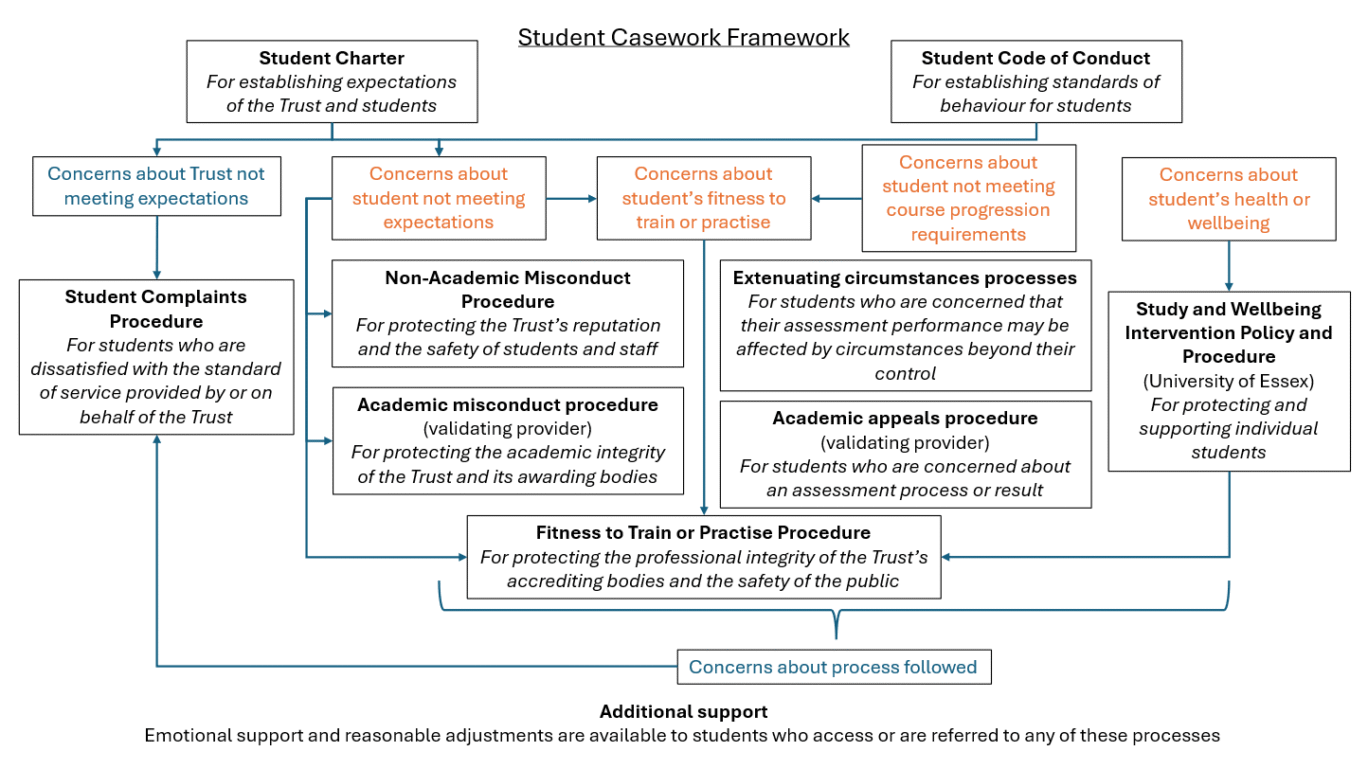
Appendix A: Student Casework Framework
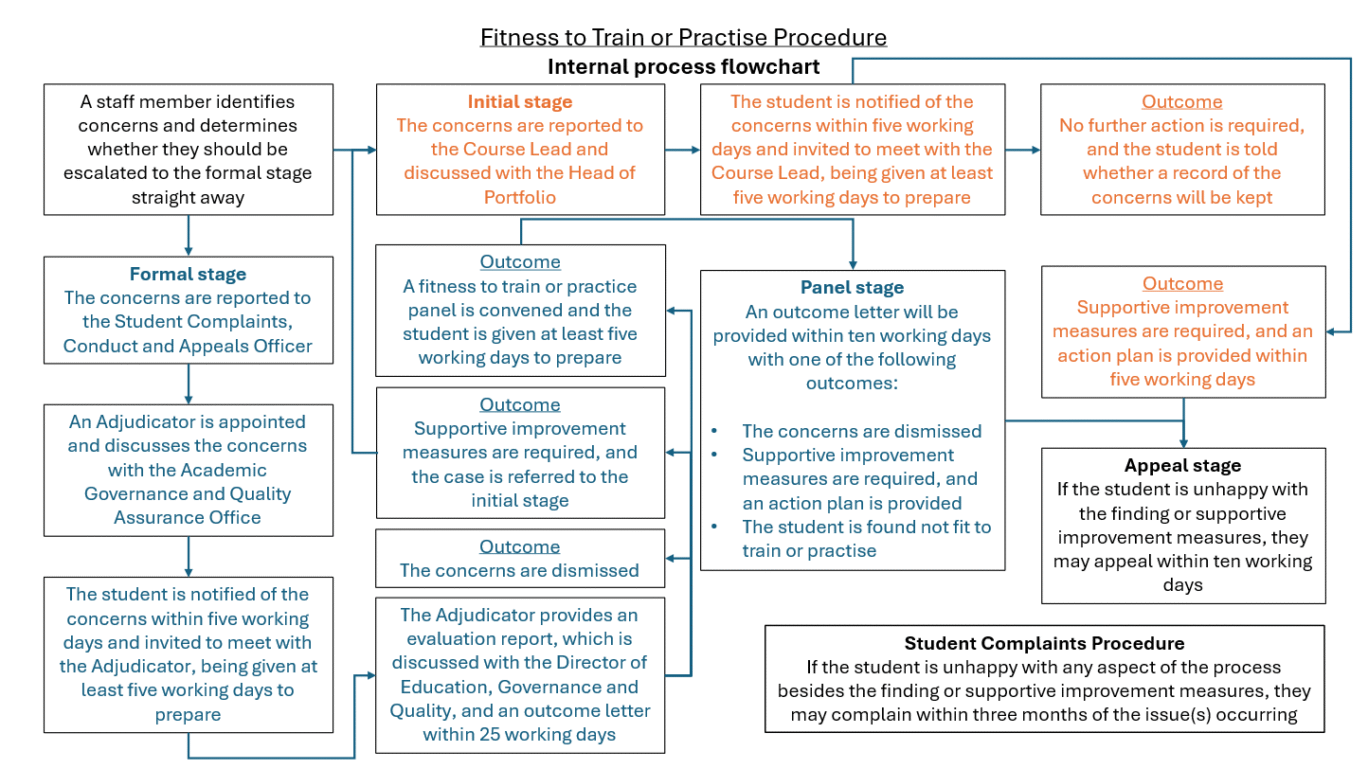
Appendix B: Internal Process Flowchart
Appendix C: Fitness to Train or Practise Action Plan