


Student Complaints Procedure
The purpose of this procedure is to ensure that students or trainees of Tavistock Education and Training (TET), part of North London NHS Foundation Trust (NLFT), can submit complaints and receive responses in a timely and helpful way.
1. Introduction
The purpose of this procedure is to ensure that students or trainees of Tavistock Education and Training (TET), part of North London NHS Foundation Trust (NLFT), can submit complaints and receive responses in a timely and helpful way.
2. Principles
This procedure is informed by the principles set out by the Office of the Independent Adjudicator for Higher Education (OIAHE) in its Good Practice Framework: Handling Complaints and Academic Appeals (December 2022). It is also informed by the principles set out by the Quality Assurance Agency (QAA) in its Advice and Guidance: Concerns, Complaints, and Appeals (November 2018).
Therefore, the procedure aims to be:
- Accessible and clear,
- Flexible, proportionate and timely,
- Fair and independent,
- Transparent and confidential as appropriate.
And the procedure is committed to:
- Treating everyone involved in any complaint with dignity and respect,
- Considering the wellbeing of everyone involved in any complaint,
- Resolving issues at the earliest opportunity,
- Improving the student experience.
It is important to note that TET considers that these principles apply equally to students and staff involved in any complaint.
3. Duties and responsibilities
The implementation of this procedure is the responsibility of TET and is overseen by the Chief Education and Training Officer/Dean of Postgraduate Studies.
Although it is intended that the named post holders will undertake the duties and responsibilities outlined in this procedure, there may occasionally be instances where one or more members of staff who would normally handle a complaint are unavailable or have a conflict of interest. In such instances, TET will appoint an appropriate nominee to replace them.
4. Advice and support
Students are encouraged to seek advice from the Student Complaints, Conduct and Appeals Officer in relation to this procedure.
The Student Complaints, Conduct and Appeals Officer can provide advice on:
- How to submit a complaint,
- Whether issues are likely to be in scope or in time for investigation,
- Reasonable adjustments while using the procedure,
- Other support available while using the procedure, such as wellbeing support,
- Other procedures which it may be appropriate for students to access.
Students should email StudentCasework@Tavi-Port.nhs.uk.
5. Scope
a. Types of issues which may constitute a student complaint
TET adopts the definition of ‘student complaint’ which is used by the OIAHE, whereby a complaint is:
“An expression of dissatisfaction by one or more students about something a provider has done or not done, or about the standard of service provided by or on behalf of the provider.”
There is not an exhaustive list of types of issue which may lead to a complaint.
Examples may include:
- TET not meeting obligations or expectations such as those outlined in course handbooks or the student charter,
- Misleading or incorrect information (for example, in prospectuses or promotional material),
- Poor quality of learning resources, facilities, or service provided by staff (including teaching and professional services staff),
- Issues affecting course delivery or student experience (including industrial action and other significant disruption),
- Issues related to policies, procedures, or processes such as those governing disability, wellbeing, and financial support.
b. Complaints and feedback
It is expected that any issues raised under this procedure will affect the student making the complaint directly and in their capacity as a student. Where a complaint only raises general concerns about TET’s policies or actions, TET may decide to respond outside of this procedure.
TET operates various mechanisms for students to provide feedback, including:
- Informal comments to, or discussions with, course staff,
- Tutorials,
- Student representatives, course committees, and Dean’s Forums,
- Student surveys at course and Trust levels.
Students are encouraged to consider whether issues may be better raised using one of these mechanisms before submitting a complaint.
More information about these mechanisms can be found on TET’s website.
c. Student behaviour while using this procedure
It is expected that students will not misuse this procedure. TET may choose not to investigate complaints which have no serious purpose, or which are intended to cause disruption or annoyance.
Similarly, it is expected that students will behave appropriately while using this procedure. TET may choose not to proceed with investigations where the student’s behaviour is unacceptable. This is likely to include abusive or threatening behaviour.
In such instances, TET will contact the student to explain how their behaviour is unacceptable and will try to work with the student to establish a way forward. Where necessary, TET may act to protect others involved in the complaint or refer students to its student conduct procedures.
If TET decides that an investigation should not proceed for these reasons, it will notify the student of this and provide an explanation. The student will have the opportunity to appeal this decision.
The grounds for appealing such a decision are:
- The student has a reasonable challenge to the decision,
- The student has new material evidence which could not have been provided sooner, and which may affect the reasonableness of the decision.
Appeals of this kind will be referred to the Head of Operations, Education and Training for consideration. If an appeal of this kind is not upheld, TET will issue a Completion of Procedures Letter (section 6d) which will set out the available next steps.
Additionally, it is expected that students will correspond with TET in a timely way while using this procedure. TET may choose not to proceed with investigations where the student does not engage effectively with the process.
In such instances, TET will contact the student to explain that their complaint will be closed if they do not engage effectively with the process.
If TET decides that an investigation should not proceed for these reasons, it will notify the student of this and provide an explanation. The student will have the opportunity to appeal this decision as above.
In exceptional cases, TET may choose to proceed with an investigation where the student has stopped engaging with the process.
In such instances, the student and any staff involved in the complaint will be provided with an explanation of TET’s decision to continue with the investigation. They will also be informed of the outcome of the investigation; however, the student’s opportunity to escalate their complaint may be limited because they did not engage with the process.
d. Delivering learning opportunities with others
Some of TET’s courses are delivered at sites other than the Tavistock Centre. These sites are known as Alternate Centres. Other courses are delivered by a provider other than TET. These providers are known as Associate Centres.
Students on these courses are encouraged to submit complaints to TET in the first instance so that the Student Complaints, Conduct and Appeals Officer may liaise with the relevant centre to determine how the complaint should be processed.
Similarly, TET’s placements are normally delivered by a provider other than TET. Where a student wishes to complain about issues associated with a placement, the Student Complaints, Conduct and Appeals Officer may liaise with the placement provider to determine how the complaint should be processed.
Finally, some of TET’s awards are conferred by a different organisation. Where a student wishes to complain about issues associated with an award or the quality of awards generally, or about services provided by the awarding body, the Student Complaints, Conduct and Appeals Officer may liaise with the awarding body to determine how the complaint should be processed.
In such instances, it may be decided that the complaint should be processed under the other organisation’s own complaints procedure, rather than this procedure.
e. Academic appeals
Students who wish to raise concerns about a decision made about their progression, academic assessment, or award are encouraged to access the relevant university partner’s academic appeals procedures in the first instance but may contact the Student Complaints, Conduct and Appeals Officer if they are unsure about which procedure to access.
f. Complaints about student behaviour
Students who wish to raise concerns about the behaviour of another student are encouraged to access the Non-Academic Misconduct Procedure in the first instance but may contact the Student Complaints, Conduct and Appeals Officer if they are unsure about which procedure to access.
g. Complaints about staff behaviour
Students who wish to raise concerns about the behaviour of a member of staff should normally submit a complaint under this procedure in the first instance.
The staff member will be informed that a complaint has been made and what support is available for them within five working days of the complaint being acknowledged.
The outcome of this procedure may include the staff member being referred to NLFT’s staff conduct procedures. The student will not normally be informed of the outcome of the staff conduct procedures.
h. Group complaints
A group of students may use this procedure to submit a single, collective complaint.
Similarly, if TET receives multiple complaints about the same issues, it may look to investigate the issues as a group complaint.
In such instances, TET will contact the students to establish:
- Whether each student named in the group complaint consents to being part of the complaint, or whether each of the students who have submitted individual complaints consent to being part of a group,
- Who should be the nominated representative for the group,
- Whether the procedure should be adapted to ensure that the complaint is handled in an effective and efficient way.
i. Complex cases
Students may access other procedures around the same time as submitting a complaint.
Similarly, some complaints may involve issues which could be better addressed under a different procedure.
In such instances, TET will contact the student to discuss:
- Whether a procedure can be adapted to ensure that all the issues raised can be considered effectively and efficiently under a single procedure,
- If more than one procedure should be followed, in which order the procedures should be invoked and whether the first procedure can be used to establish the facts so that any other procedures can be streamlined,
- What, if anything, the student needs to do to progress another procedure,
- Any implications for the student of invoking multiple procedures.
TET will make the final decision about how to progress complex cases and the student will be informed about this decision before any proceedings commence.
If a student refers any of the issues raised in their complaint to an external organisation, such as a court or tribunal, TET will normally suspend this procedure until the external processes have been completed.
j. Anonymous and third-party complaints
TET is committed to ensuring that this procedure is accessible to all students. This means that students should not need to make complaints through third parties. If TET decides to accept a complaint made through a third party, the student will be asked to confirm in writing that they consent for the third party to act as their representative.
Similarly, TET is committed to ensuring that no student is disadvantaged by making a complaint. This means that students should not need to make complaints anonymously. If TET decides to accept an anonymous complaint, its ability to investigate and respond to the issues, and to support the student, may be limited.
6. Making a complaint
a. Following the stages
It is expected that students will follow the stages of the procedure as set out below without skipping any stages. This means that, if a formal complaint is submitted in the first instance, or if a student contacts a senior member of staff directly to make a complaint, it will normally be referred to the informal stage of the procedure.
TET recognises that there may occasionally be good reasons for beginning proceedings at the formal stage. This is likely to depend on the nature and seriousness of the issues raised, the complexity of the case, and the outcome the student is seeking. TET is committed to considering each case on its individual merits.
b. Informal stage
i. Submission
TET is committed to trying to resolve complaints quickly and as close to the point of service delivery as possible.
Student should normally make complaints to a relevant member of staff in the first instance. If the student is unsure who to raise their concerns with, they should contact the Student Complaints, Conduct and Appeals Officer.
Students should make informal complaints within three months of the relevant issues occurring. If a complaint is made more than three months after the relevant issues occurred, the student will be asked to explain why they could not make a complaint sooner and may be asked to provide evidence which supports this.
To be fair to all students, TET may only decide to accept a late complaint if there is a good reason for doing so.
In such instances, TET will consider:
- Its obligations under the relevant equalities legislation,
- The student’s individual circumstances,
- The nature and seriousness of the issues raised,
- Whether it is still reasonably possible to investigate the issues.
If a member of staff who receives an informal complaint thinks that it should be rejected (for example, because the issues raised are not in time for investigation), they should contact the Student Complaints, Conduct and Appeals Officer who will decide whether TET should issue a Completion of Procedures Letter (section 6d).
ii. Investigation
TET will appoint a Resolution Facilitator to try to resolve the complaint.
Members of staff who receive informal complaints may try to facilitate resolution by themselves or ask another staff member to do so. If the staff member is unsure who to appoint, they should contact the Student Complaints, Conduct and Appeals Officer.
Similarly, if the staff member thinks that the complaint should be escalated to the formal stage straight away, they should contact the Student Complaints, Conduct and Appeals Officer.
The Resolution Facilitator will normally try to resolve the complaint within 25 working days of the complaint being submitted. If this process is likely to be delayed for any reason, the Resolution Facilitator will contact the student to provide an explanation and propose a revised deadline.
This will normally involve:
- Meeting with the student to confirm what their complaint is about, what outcome they are seeking, and what support they require,
- Contacting relevant staff to enquire about resolving the issues,
- Writing to the student to confirm what action has been taken, the outcome, and the next steps.
It may also involve mediation or conciliation, whereby the Resolution Facilitator acts as an impartial third party and helps the student and someone they have a dispute with try to resolve their problem or reach an agreement. These processes are voluntary and confidential.
The Resolution Facilitator will inform the Student Complaints, Conduct and Appeals Officer of the action taken and the outcome of the complaint.
If a student is dissatisfied with the outcome of the informal stage, they may escalate their complaint to the formal stage.
c. Formal stage
i. Submission
Students are encouraged to use TET’s online formal complaint form to submit their complaint and to clearly set out their concerns, the outcome they are seeking, and any support they require. The student may be asked to complete this form if they submit their complaint in a different format.
Students should submit formal complaints within three months of the relevant issues occurring or within 25 working days of the informal stage outcome being issued, whichever is later.
ii. Initial evaluation
Within ten working days of receiving a formal complaint, the Student Complaints, Conduct and Appeals Officer will carry out an initial evaluation of the complaint to confirm whether the issues raised are in scope or in time for investigation and whether the outcome the student is seeking is possible.
As above, TET may decide to refer the complaint to the informal stage if that stage has been skipped and may only decide to accept a late complaint if there is a good reason for doing so.
If a complaint is rejected (for example, because the issues raised are not in time for investigation), TET will notify the student of this and provide an explanation. The student will have the opportunity to appeal this decision.
The grounds for appealing such a decision are:
- The student has a reasonable challenge to the decision,
- The student has new material evidence which could not have been provided sooner, and which may affect the reasonableness of the decision.
Appeals of this kind will be referred to the Head of Operations, Education and Training for consideration. If an appeal of this kind is not upheld, TET will issue a Completion of Procedures Letter (section 6d) which will set out the available next steps.
If a complaint is accepted, the student will receive an acknowledgement letter which states the issues which will be investigated and the outcome the student is seeking.
The letter will also explain what support is available for the student and set out the next steps, including inviting the student to provide any evidence to support their complaint and informing them of TET’s deadline to respond to the complaint.
Any evidence which the student provides may be shared with others involved in the investigation if appropriate, including members of staff who are being asked to respond to the complaint.
iii. Investigation
TET will appoint an independent Complaint Investigator to try to resolve the complaint.
This person will be a senior member of staff such as a Head of Portfolio or Head of Professional Services outside of the area which is the subject of the complaint.
The Complaint Investigator will normally try to resolve the complaint within 90 calendar days of the complaint being acknowledged. If this process is likely to be delayed for any reason, TET will contact the student to provide an explanation and propose a revised deadline.
The student will be offered a meeting with the Complaint Investigator.
The Complaint Investigator will normally also meet with relevant staff members and may request evidence from these staff members, other staff across TET, NLFT, or any national centres, or staff at other organisations as appropriate.
Students and staff may be accompanied at complaint meetings, normally by a fellow student, colleague, or trade union adviser.
The Student Complaints, Conduct and Appeals Officer will attend all complaint meetings to answer any questions about the procedure and take notes. Meeting notes will be shared with all attendees, and they will have the opportunity to propose any amendments.
If someone declines a meeting invitation, they will be asked to provide a written statement which addresses the issues raised in the complaint.
Once they have heard from the relevant students and staff, and gathered sufficient evidence, the Complaint Investigator will compile an investigation report which details the action taken and their conclusions.
The report will be shared with the Student Complaints, Conduct and Appeals Officer and one of the Directors of Education in the first instance, and the final version will be shared with those involved in the investigation as appropriate.
iv. Outcomes
As above, mediation or conciliation may be used to try to resolve the complaint, with the Complaint Investigator acting as an impartial third party and helping the student and someone they have a dispute with try to resolve their problem or reach an agreement.
TET may also try to settle the complaint, whereby an agreement is reached between TET and the student which resolves some of, or all the issues raised.
Settlement offers will be made in writing to students, and they will have a reasonable period to respond, normally ten working days. If a student accepts an offer in full and final settlement of some of, or all the issues raised in their complaint, they will not be able to take further action in relation to the same issues.
For any issues which are not resolved through mediation, conciliation, or settlement, the Complaint Investigator will decide whether they are Upheld, Partly Upheld, or Not Upheld.
For any issues which are Upheld or Partly Upheld, TET will normally make recommendations to TET to help prevent the issues from occurring again in the future. It may also make one or more offers to the student to put things right for them, which will remain open for a reasonable period, normally ten working days.
All outcomes will be recorded in the investigation report and confirmed in an outcome letter to the student.
If a student is dissatisfied with the outcome of the formal stage, they may request an internal review.
If a student does not request an internal review, TET will issue a Completion of Procedures Letter (section 6d) within 28 days of the formal stage outcome being issued.
d. Internal review stage
i. Submission
Students are encouraged to use TET’s online internal review form to request a review and to clearly set out the grounds for their request, their concerns about the formal process, and any support they require. The student may be asked to complete the form if they submit their request in a different format.
Students should submit requests within ten working days of the formal stage outcome being issued.
The grounds for requesting a review are:
- This procedure was not followed, or a procedural error occurred during the formal process,
- The outcome of the formal process was unreasonable,
- The student has new material evidence which could not have been provided sooner, and which may affect the outcome of the formal process.
ii. Initial evaluation
Within ten working days of receiving a review request, the Student Complaints, Conduct and Appeals Officer will carry out an initial evaluation of the request to confirm whether it is in scope or in time for consideration and whether it meets any of the above grounds.
As above, TET may only decide to accept a late request if there is a good reason for doing so.
If a request is rejected (for example, because it was not submitted in time for consideration), TET will notify the student of this and provide an explanation. The student will have the opportunity to appeal this decision.
The grounds for appealing such a decision are:
- The decision was unreasonable,
- The student has new material evidence which could not have been provided sooner, and which may affect the reasonableness of the decision.
Appeals of this kind will be referred to the Head of Operations, Education and Training for consideration. If an appeal of this kind is not upheld, TET will issue a Completion of Procedures Letter (section 6d) which will set out the available next steps.
If a request is accepted, the student will receive an acknowledgement letter which states the issues which will be considered under which grounds.
The letter will also explain what support is available for the student and set out the next steps, including inviting the student to provide any evidence to support their request and informing them of TET’s deadline to respond to the request.
Any evidence which the student provides may be shared with others involved in the investigation if appropriate, including members of staff who are being asked to respond to the complaint.
iii. Consideration
TET will ask the Chief Education and Training Officer/Dean of Postgraduate Studies to consider the review request, and they will be provided with all the information which was considered as part of the formal investigation.
The Chief Education and Training Officer/Dean of Postgraduate Studies will normally try to respond to the request within 25 working days of the request being acknowledged. If the response is likely to be delayed for any reason, TET will contact the student to provide an explanation and propose a revised deadline.
The review will not normally revisit any of the issues which were raised in the formal complaint; rather, the Chief Education and Training Officer/Dean of Postgraduate Studies will consider whether the formal process was conducted appropriately.
This may involve:
- Meeting with those involved in the formal investigation,
- Requesting additional documentation,
- Consulting with other individuals and groups as appropriate.
iv. Outcomes
The Chief Education and Training Officer/Dean of Postgraduate Studies will decide whether the review request is Upheld, Partly Upheld, or Not Upheld.
For any parts of the request which are Upheld or Partly Upheld, the Chief Education and Training Officer/Dean of Postgraduate Studies will normally make recommendations to TET to help prevent the issues from occurring again in the future. They may also make one or more offers to the student to put things right for them, which will remain open for a reasonable period, normally ten working days.
In such instances, the Chief Education and Training Officer/Dean of Postgraduate Studies may offer to replace the formal stage outcome with a different outcome, or to arrange for one or more parts of the formal complaint to be reinvestigated.
All outcomes will be confirmed in an outcome letter to the student.
For any parts of the formal complaint which will not be reinvestigated, TET will issue a Completion of Procedures Letter (section 6d) within 28 days of the internal review stage outcome being issued.
e. External review stage
i. Validated courses
For students on validated courses, once TET has issued a Completion of Procedures Letter, they may submit a complaint to the OIAHE if they remain dissatisfied.
The OIAHE is the independent student complaints scheme for England and Wales. More information about the scheme can be found on the OIAHE’s website.
Students must submit complaints to the OIAHE within 12 months of their Completion of Procedures Letter being issued.
ii. Non-validated courses
For students on non-validated courses, once TET has issued a Completion of Procedures Letter, they are encouraged to seek advice from the Student Complaints, Conduct and Appeals Officer if they remain dissatisfied and are unsure about the next steps.
7. Confidentiality
TET is committed to ensuring that all student casework is handled with an appropriate level of confidentiality.
Information disclosed under this procedure will normally be shared only with those who need it for the purposes of investigating or responding to the matters raised.
Similarly, information requests made under this procedure will be anonymised where possible and information will be processed in line with TET’s obligations under the relevant data protection legislation.
8. Quality assurance
TET is committed to ensuring that complaints are handled consistently and by staff with an appropriate level of understanding.
TET operates various mechanisms for ensuring this, including:
- Regular training for staff, including complaints handling, data protection, and equality and diversity training,
- Quarterly reports to TET’s Academic Governance and Quality Assurance Group which state the numbers of complaints received, their outcomes, and the time taken to resolve them,
- Annual reports to TET’s Board of Directors via the Education and Research Committee which analyse anonymised complaints information, including information about recommendations and offers made.
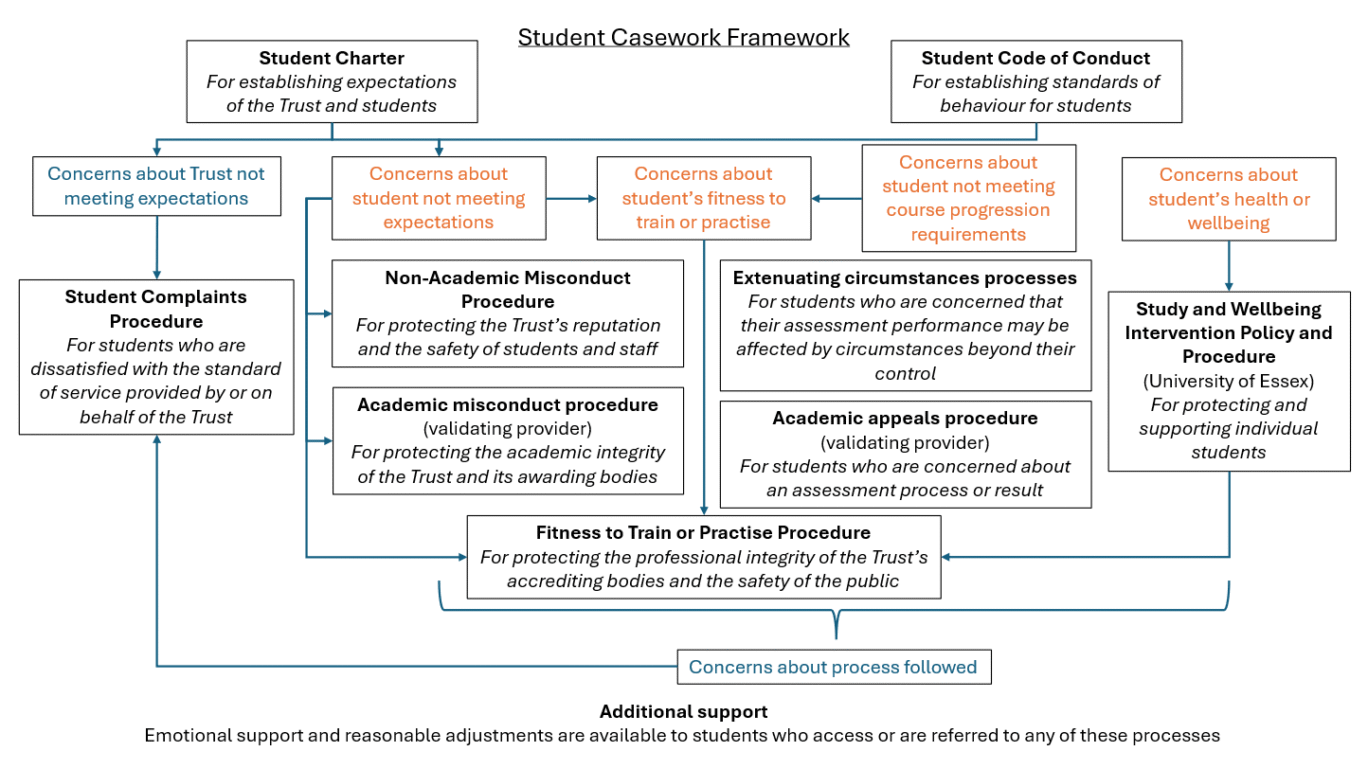
Appendix A: Student Casework Framework
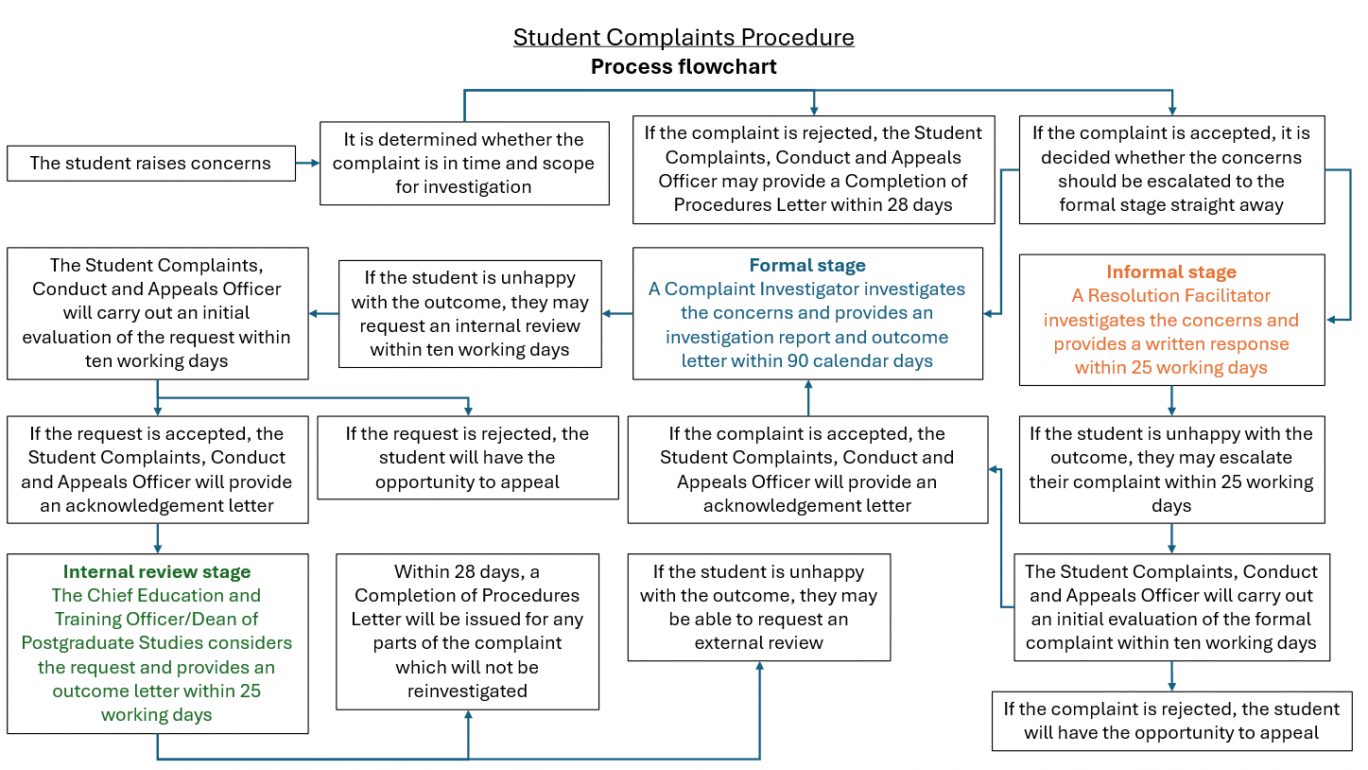
Appendix B: Process Flowchart