


Non-Academic Misconduct Procedure
The purpose of this procedure is to ensure that any concerns about the behaviour of students or trainees of Tavistock Education and Training (TET), part of North London NHS Foundation Trust (NLFT), can be addressed appropriately.
1. Introduction
The purpose of this procedure is to ensure that any concerns about the behaviour of students or trainees of Tavistock Education and Training (TET), part of North London NHS Foundation Trust (NLFT), can be addressed appropriately.
2. Principles
This procedure is informed by the principles set out by the Office of the Independent Adjudicator for Higher Education (OIAHE) in its Good Practice Framework: Disciplinary Procedures (October 2018). It is also informed by the principles set out by Pinsent Masons LLP in its Guidance for Higher Education Institutions: How to Handle Alleged Student Misconduct Which May Also Constitute a Criminal Offence (December 2022).
Therefore, the procedure aims to be:
- Accessible and clear,
- Flexible, proportionate and timely,
- Fair and independent,
- Transparent and confidential as appropriate.
And the procedure is committed to:
- Following the principles of natural justice,
- Treating everyone involved in any case with dignity and respect,
- Considering the wellbeing of everyone involved in any case,
- Resolving issues at the earliest opportunity,
- Promoting positive behaviours and improving the student experience.
3. Duties and responsibilities
The implementation of this procedure is the responsibility of TET and is overseen by the Chief Education and Training Officer/Dean of Postgraduate Studies.
Although it is intended that the named post holders will undertake the duties and responsibilities outlined in this procedure, there may occasionally be instances where one or more members of staff who would normally handle a referral are unavailable or have a conflict of interest. In such instances, TET will appoint an appropriate nominee to replace them.
4. Scope
a. Types of behaviour which may constitute non-academic misconduct
It is expected that students will always behave in a manner which is consistent with NLFT’s values, the Student Charter and the Student Code of Conduct.
Any behaviour which contravenes these values, the charter or the code of conduct is likely to constitute non-academic misconduct and result in students being referred to this procedure.
There is not an exhaustive list of types of behaviour which may constitute non-academic misconduct.
Examples may include:
- Antisocial or violent behaviour,
- Harassment or sexual misconduct,
- Hate crimes,
- Inappropriate, abusive or threatening behaviour (including online),
- Behaviour which disrupts teaching or learning,
- Behaviour which compromises the safety or wellbeing of others,
- Behaviour which is likely to bring TET, NLFT, or any national centres into disrepute, such as disruptive behaviour in the community,
- Behaviour which involves the use of forged, falsified or fraudulent documentation,
- Other behaviour which may constitute a criminal offence.
Types of behaviour which may constitute academic misconduct are outlined in, and will normally be addressed under, the University of Essex’s Academic Offences Procedures.
b. Harassment, discrimination and bullying
TET operates a zero-tolerance approach to harassment, discrimination and bulling and this procedure may be used to address students’ behaviour which may constitute harassment, discrimination or bullying.
Anyone wishing to raise concerns about a student’s behaviour which may constitute harassment, discrimination or bullying is encouraged to access this procedure in the first instance so that TET may determine how the concerns should be addressed.
c. Accredited courses
Any student of TET may be referred to this procedure. For courses which lead to a professional accreditation, there may be additional conduct expectations which students must adhere to.
If appropriate, TET will liaise with the relevant professional bodies to determine how the concerns should be addressed, and students may also be referred to the Fitness to Train or Practise Procedure.
Similarly, TET may inform the student’s placement provider or relevant professional body that they have been referred to this procedure and of the outcome.
d. Students and employees
Students may also be employed by NLFT at the time when concerns about their behaviour are raised.
In such instances, TET will refer to its human resources policies and procedures before determining how the concerns should be addressed, and it may be decided that the student should be investigated under NLFT’s staff conduct procedures.
e. Former students
Former students of TET may be referred to this procedure.
In such instances, TET will consider whether the concerns raised about the student’s behaviour relate to issues which occurred while they were a student of TET and, if so, how much time has passed since they stopped being a student of TET.
Normally, if the issues occurred during the student’s studies and can still reasonably be investigated, TET will address the concerns in line with the stages set out below.
f. Cases involving more than one student
Normally, if concerns are raised about the behaviour of multiple students at once, TET will address them in line with the stages set out below.
In such instances, TET will try to ensure:
- That the students have equal opportunities to respond to the concerns and to raise sensitive matters confidentially,
- That each student has access to information provided by the other students as appropriate,
- If a disciplinary panel hearing is required, whether it would be appropriate to invite all the students to the same hearing,
- That decisions are made and, if appropriate, penalties are applied consistently across the students but, equally, each student’s particular circumstances are given due consideration.
g. Cases which require immediate action
TET may deviate from the stages set out below if particularly swift action is required.
There is not an exhaustive list of such instances.
Examples may include:
- The case involves a threat of serious harm or disruption to the student, others or Trust activities,
- The student’s mental health is at risk, or they have displayed significant distress,
- The issues are highly sensitive.
In such instances, TET may take appropriate precautionary measures while a full investigation is completed, including:
- Limiting access to Trust or other relevant premises, grounds, facilities or services,
- Limiting contact with patients,
- Imposing a period of temporary suspension from the student’s course or placement.
- Taking a precautionary measure does not indicate that TET has concluded that the student is guilty of non-academic misconduct.
If a precautionary measure is taken, it will be reviewed periodically as the investigation progresses. If the investigation overruns, it may be necessary to extend the precautionary measure.
If TET decides that a precautionary measure should be taken or extended, it will notify the student of this and provide an explanation. The student will have the opportunity to appeal this decision. If an appeal of this kind is not upheld, TET will issue a Completion of Procedures Letter which the student may take to the OIAHE or appropriate external organisation.
h. Behaviour which may constitute a criminal offence
TET will provide appropriate and relevant information and support to students who are involved in raising or responding to concerns about behaviour which may constitute a criminal offence without putting pressure on them to take a particular course of action.
In exceptional circumstances, TET may report an alleged crime to the police itself (for example, where TET is the victim of the crime or where this is necessary to protect someone from harm or to prevent a further crime taking place).
If an external organisation, such as the police or courts, become involved in addressing concerns about a student’s behaviour, TET will normally suspend this procedure until the external processes have been completed but may take appropriate precautionary measures while they are ongoing.
5. Burden and standard of proof
In non-academic misconduct cases, the burden of proof is on TET. This means that TET must prove that the student has done what they are accused of doing, using evidence and explaining how the incident or behaviour constitutes non-academic misconduct.
If the student subsequently wishes to dispute the allegation, they must rebut it using evidence, including of any mitigating circumstances or factors that they wish to rely on.
TET will use the standard of proof which is normally used in civil cases: the balance of probabilities. This means that the evidence must show that it is more likely than not that the student has done what they are accused of doing.
6. Raising concerns
a. How to raise concerns
Anyone may raise concerns about a student’s behaviour, including other students, members of Trust staff and members of the public.
Those wishing to raise concerns should contact the Student Complaints, Conduct and Appeals Officer by emailing StudentCasework@Tavi-Port.nhs.uk and clearly setting out their concerns and any support they require.
The Student Complaints, Conduct and Appeals Officer will acknowledge receipt of the submission, normally within five working days. This will include confirming whether any clarification or further information is required from the person raising concerns (the reporting person) and what TET will do next regarding the concerns.
For the reporting person, the Student Complaints, Conduct and Appeals Officer can provide advice on:
- Whether concerns are likely to be in scope for investigation,
- Reasonable adjustments while accessing the procedure,
- Other support available while accessing the procedure, such as wellbeing support,
- Other procedures which it may be appropriate for the reporting person to access.
b. Raising concerns anonymously
TET is committed to providing support for anyone who raises concerns about a student’s behaviour. This means that it should not be necessary to raise concerns anonymously. If the reporting person wishes to remain anonymous, TET’s ability to address the concerns or provide support may be limited. Similarly, it is not normally appropriate to keep the identity of any witnesses a secret during proceedings as this may undermine the student’s ability to defend themselves. If a witness wishes to remain anonymous, TET’s ability to rely on their evidence may be limited.
7. Addressing concerns
a. Initial stage
i. Communicating the concerns
The Student Complaints, Conduct and Appeals Officer will notify the student who is the subject of the concerns raised (the reported student), normally within five working days. This will include providing any available supporting evidence and inviting the reported student to respond.
The reported student will normally be given five working days to respond to the concerns and may request a meeting with the Student Complaints, Conduct and Appeals Officer to discuss their response.
For the reported student, the Student Complaints, Conduct and Appeals Officer can provide advice on:
- What information should be included in the response,
- Reasonable adjustments for the reported student,
- Other support available to reported students, such as wellbeing support,
- Other procedures which it may be appropriate for the reported student to access.
The reported student may choose not to provide a response, but TET will continue to address the concerns in line with this procedure.
If the reported student has been given a reasonable opportunity to provide a response and has not engaged with the process, TET will continue to address the concerns in line with this procedure and may proceed to the formal stage.
ii. Investigating the concerns
If the reported student has previously been found guilty of an offence under this procedure, the case may be escalated to the formal stage straight away. Cases of this kind will be referred to the Head of Operations, Education and Training to decide whether they should be escalated. Details of the previous offence will not normally be shared with the investigator until potential penalties are being considered.
If the reported student has not previously been found guilty of an offence under this procedure, TET will appoint an independent Initial Investigator to address the concerns. This person will normally be a Course Lead for a course in a portfolio other than the portfolio which oversees the reported student’s course.
The Initial Investigator will make enquiries to try to establish the validity and severity of the concerns. They may contact the reporting person, the reported person, and others directly as part of this process. They will keep records of their enquiries and any meetings.
If the concerns are related to a dispute between the reporting person and the reported student, the Initial Investigator may attempt to resolve these concerns through mediation or conciliation, acting as an impartial third party to facilitate resolving the problem or reaching an agreement. These processes are voluntary and confidential.
iii. Communicating the outcome
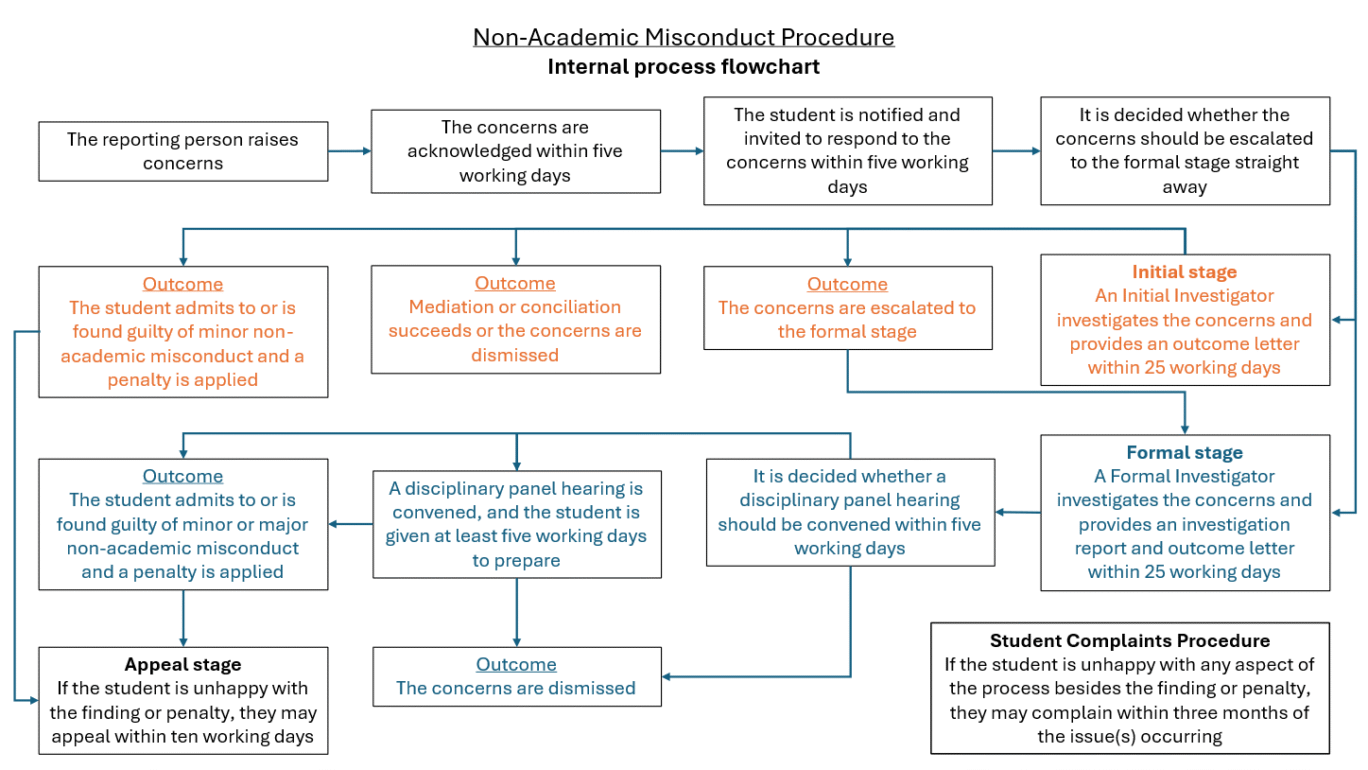
The outcome of the initial stage will normally be one of the following:
- Mediation or conciliation succeeds, or the concerns are dismissed,
- The student admits to or is found guilty of minor non-academic misconduct, and a proportionate penalty is applied (the student may proceed to the appeal stage),
- Mediation or conciliation fails, further investigation is required, or the concerns are deemed serious, and the case is escalated to the formal stage.
The Initial Investigator, in liaison with the Student Complaints, Conduct and Appeals Officer, will issue an outcome letter to the reported student, normally within 25 working days of the concerns being raised, which sets out the implications of any penalties applied and the next steps. The reporting person may also be notified of the action taken and outcome as appropriate.
If the outcome is likely to be delayed for any reason, TET will contact the reported student to provide an explanation and propose a revised deadline.
b. Formal stage
i. Investigating the concerns
TET will appoint an independent Formal Investigator to address the concerns. This person will be a senior member of staff and normally a Head of Portfolio but not the portfolio which oversees the reported student’s course. The Formal Investigator will make enquiries to try to establish the validity and severity of the concerns. The Formal Investigator may arrange meetings with the reporting person, the reported person, and others as part of this process in liaison with the Student Complaints, Conduct and Appeals Officer.
Interviewees may be accompanied at these meetings, normally by a fellow student or colleague.
The Student Complaints, Conduct and Appeals Officer will attend these meetings to answer any questions about the procedure and take notes. Meeting notes will be shared with all attendees, and they will have the opportunity to propose any amendments.
If the Formal Investigator decides that the concerns are serious, or the potential consequences for the student are severe, they will convene a disciplinary panel hearing in liaison with the Student Complaints, Conduct and Appeals Officer.
The decision to convene a disciplinary panel hearing will normally be made within five working days of the case being escalated to the formal stage.
ii. Disciplinary panel hearing
The reported student will be given at least five working days to prepare for the hearing and will be provided with details of the panel members and copies of any documentation which they will consider. The reported student may be accompanied at the hearing, normally by a fellow student or member of Trust staff.
The student may ask to call witnesses, but the Formal Investigator will make the final decision about whether this should be allowed. The reasons for this decision will be communicated in writing to the student.
The hearing may take place as an in-person, online or hybrid meeting and all attendees will be asked for their preference.
The reported student may choose not to attend the hearing, but TET will continue to address the concerns in line with this procedure. The student may choose to provide a written statement instead of attending the hearing.
If the reported student has been given a reasonable opportunity to confirm their attendance or provide a written statement and has not engaged with the process, TET will continue to address the concerns in line with this procedure.
If the reported student or their companion cannot attend on the day of the hearing for a good reason, they will normally be offered one further opportunity to attend.
The panel membership will normally consist of the Formal Investigator, who will act as the Chair, and two other senior members of staff.
The protocol for disciplinary hearings is:
- Introductions,
- The Chair will set out the concerns and invite the reported student and any witnesses to respond (or set out the reported student’s written statement),
- Panel members may ask the reported student and any witnesses questions (or discuss the reported student’s written statement),
- The reported student may ask witnesses to clarify any points, ask panel members questions, and make any final comments,
- The Chair will summarise the meeting and set out the next steps for the reported student and any witnesses and ask them to leave,
- Panel members will deliberate and agree an outcome and, if applicable, a penalty.
If further information is required before panel members can agree an outcome or penalty, the panel may arrange a follow-up meeting once the outstanding information has been obtained. In such instances, the reported student will be kept informed about how their case is being progressed.
The Student Complaints, Conduct and Appeals Officer will attend the hearing and any follow-up meetings to answer any questions about the procedure and take notes. The notes will be shared with all attendees, and they will have the opportunity to propose any amendments.
iii. Communicating the outcome
Once they have heard from the relevant people and gathered sufficient evidence, the Formal Investigator will compile an investigation report which details the action taken and their findings.
The report will be shared with the Student Complaints, Conduct and Appeals Officer and one of the Directors of Education in the first instance.
- The outcome of the formal stage will normally be one of the following:
- The concerns are dismissed,
- The student admits to or is found guilty of minor or major non-academic misconduct, and a proportionate penalty is applied (the student may proceed to the appeal stage).
The Formal Investigator, in liaison with the Student Complaints, Conduct and Appeals Officer, will share the investigation report with the reported student, normally within 25 working days of the case being escalated to the formal stage.
The reported student will also be issued with an outcome letter which sets out the implications of any penalties applied and the next steps, and the reporting person may also be notified of the action taken and outcome as appropriate.
If the outcome is likely to be delayed for any reason, TET will contact the reported student to provide an explanation and propose a revised deadline.
c. Penalties
i. Applying a penalty
When applying a penalty, TET will consider:
- The reported student’s previous disciplinary record,
- Any mitigating circumstances or factors (including whether the student admitted to the offence and, if so, at what point during the process),
- The implications of each penalty for the reported student and others as appropriate.
TET will consider each of the available penalties from the least to most severe as set out below until a proportionate penalty is reached. Multiple penalties may be applied.
ii. Potential penalties
The tables below set out the types of penalty which are likely to be applied for certain offences, but the examples are illustrative only. This is because there may be instances where, for example, an offence which might ordinarily be classed as minor is in fact major and requires a more severe penalty.
The available penalties for minor offences are normally:
| Example of offence | Proportionate penalty |
| Behaviour which is borderline inappropriate or risks disrupting teaching or learning | Informal warning |
| Behaviour which is accidentally inappropriate or disrupts teaching or learning | Formal warning |
| Behaviour which is likely to bring TET, NLFT, or any national centres into disrepute, such as disruptive behaviour in the community | Apology or reflective statement |
| Behaviour which unintentionally compromises the safety or wellbeing of others or is accidentally abusive or threatening | Restorative meeting(s), training or, if available, community service |
The available penalties for major offences are normally:
| Example of offence | Proportionate penalty |
| Behaviour which involves attempted or actual theft or vandalism of another’s or Trust property | Monetary fine or reimbursement or, if available, equivalent community service |
| Antisocial or violent behaviour | Temporary or permanent exclusion from Trust or other relevant premises, grounds, facilities or services |
| Behaviour which intentionally compromises the safety or wellbeing of others or is deliberately abusive or threatening | Temporary or permanent expulsion |
Informal warnings will not normally be recorded on the student’s record, but any other penalty will normally be recorded.
iii. Communicating the penalty
As above, the penalty and its implications for the reported student will be set out for them in an outcome letter.
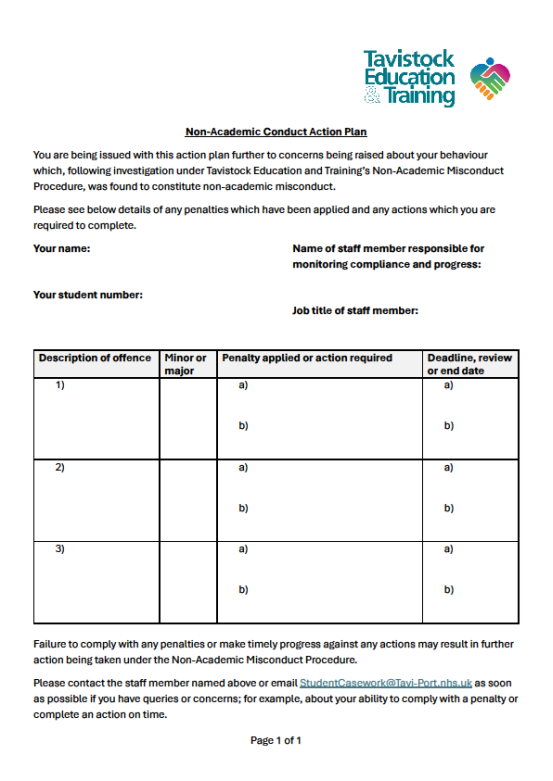
If a penalty is applied, the outcome letter will include a non-academic conduct action plan (Appendix C) which sets out the specifics of the penalty, including the duration (for example, of any temporary exclusion or expulsion), how the student’s progress against the actions will be monitored, the consequences of not complying with any actions and whether there is any scope for the penalty to be reviewed later.
d. Appeal stage
i. Submitting an appeal
The reported student may appeal against a finding that they are guilty of non-academic misconduct or against the penalty applied.
The student should email StudentCasework@Tavi-Port.nhs.uk and clearly set out the grounds for their appeal, their concerns about the process, and any support they require.
The student should submit their appeal within ten working days of the outcome being issued.
The grounds for appeal are:
- This procedure was not followed, or a procedural error occurred during the process,
- The process was affected by bias or a reasonable perception of bias,
- The finding was unreasonable,
- The penalty applied was disproportionate or not allowed under this procedure,
- The student has new material evidence which could not have been provided sooner, and which may affect the outcome of the process.
If the reported student does not wish to appeal the finding or penalty applied but is dissatisfied with another aspect of the process, they may be able to submit a complaint under the Student Complaints Procedure.
Similarly, if the reporting person is a student or any of the witnesses are students and they are dissatisfied with some aspect of the process, they may be able to submit a complaint.
ii. Considering the appeal – initial evaluation
Within ten working days of receiving an appeal, the Student Complaints, Conduct and Appeals Officer will carry out an initial evaluation of the appeal to confirm whether it is in scope or in time for consideration and whether it meets any of the above grounds.
TET may only decide to accept a late appeal if there is a good reason for doing so.
In such instances, TET will consider:
- Its obligations under the relevant equalities legislation,
- The student’s individual circumstances,
- The nature and seriousness of the issues raised,
- Whether it is still reasonably possible to investigate the issues.
If an appeal is rejected (for example, because it was not submitted in time for consideration), TET will notify the student of this and provide an explanation. The student will have the opportunity to request a review of this decision.
The grounds for requesting this type of review are:
- The student has a reasonable challenge to the decision,
- The student has new material evidence which could not have been provided sooner, and which may affect the reasonableness of the decision.
Requests of this kind will be referred to the Head of Operations, Education and Training for consideration. If a request of this kind is not upheld, TET will issue a Completion of Procedures Letter which the student may take to the OIAHE or appropriate external organisation.
If an appeal is accepted, the student will receive an acknowledgement letter which states the issues which will be considered under which grounds.
The letter will also explain what support is available for the student and set out the next steps, including inviting the student to provide any evidence to support their appeal and informing them of TET’s deadline to respond to the appeal.
iii. Considering the appeal – full consideration
TET will ask the Chief Education and Training Officer/Dean of Postgraduate Studies to consider the appeal, and they will be provided with all information which was considered at the initial and, if applicable, formal stages.
The Chief Education and Training Officer/Dean of Postgraduate Studies will normally try to respond to the appeal within 25 working days of the appeal being acknowledged. If the response is likely to be delayed for any reason, TET will contact the student to provide an explanation and propose a revised deadline.
Full consideration of an appeal may involve:
- Meeting with those involved in the initial or formal stages,
- Requesting additional documentation,
- Consulting with other individuals and groups as appropriate.
iv. Communicating the outcome
The Chief Education and Training Officer/Dean of Postgraduate Studies will decide whether the appeal is Upheld, Partly Upheld, or Not Upheld.
For any parts of the appeal which are Upheld or Partly Upheld, the Chief Education and Training Officer/Dean of Postgraduate Studies will normally make recommendations to TET to help prevent the issues from occurring again in the future. They may also offer one or more remedies to the student.
In such instances, the Chief Education and Training Officer/Dean of Postgraduate Studies may offer to refer the case to the initial or formal stages for reinvestigation or further investigation, or to reconvene the disciplinary panel hearing or convene a new disciplinary panel hearing.
In exceptional circumstances, the Chief Education and Training Officer/Dean of Postgraduate Studies may offer to amend the finding or to apply an alternative penalty or penalties.
All outcomes will be confirmed in an outcome letter to the student, and any offers will remain open for a reasonable period, normally ten working days.
For any parts of the appeal which are Not Upheld, TET will issue a Completion of Procedures Letter within 28 days of the appeal outcome being issued. The student may take this letter to the OIAHE or appropriate external organisation.
For any parts of the appeal which are Upheld or Partly Upheld, the student may request a Completion of Procedures Letter. Once issued, the student may take this letter to the OIAHE or appropriate external organisation.
e. External review stage
i. Validated courses
For students on validated courses, once TET has issued a Completion of Procedures Letter, they may submit a complaint to the OIAHE if they are dissatisfied.
The OIAHE is the independent student complaints scheme for England and Wales. More information about the scheme can be found on the OIAHE’s website.
Students must submit complaints to the OIAHE within 12 months of their Completion of Procedures Letter being issued.
ii. Non-validated courses
For students on non-validated courses, once TET has issued a Completion of Procedures Letter, they are encouraged to seek advice from the Student Complaints, Conduct and Appeals Officer if they are dissatisfied.
8. Confidentiality
TET is committed to ensuring that all student casework is handled with an appropriate level of confidentiality.
Information disclosed under this procedure will normally be shared only with those who need it for the purposes of investigating or responding to the matters raised.
Similarly, information requests made under this procedure will be anonymised where possible and information will be processed in line with TET’s obligations under the relevant data protection legislation.
It is expected that all those involved in TET’s student casework processes will treat cases confidentially and will not share information with others outside of the process unless strictly necessary.
9. Quality assurance
TET is committed to ensuring that non-academic misconduct cases are handled consistently and by staff with an appropriate level of understanding.
TET operates various mechanisms for ensuring this, including:
- Regular training for staff, including data protection and equality and diversity training,
- Quarterly reports to TET’s Academic Governance and Quality Assurance Group and annual reports to its Board of Directors via the Education and Research Committee which analyse anonymised case information, including information about penalties applied and appeals.
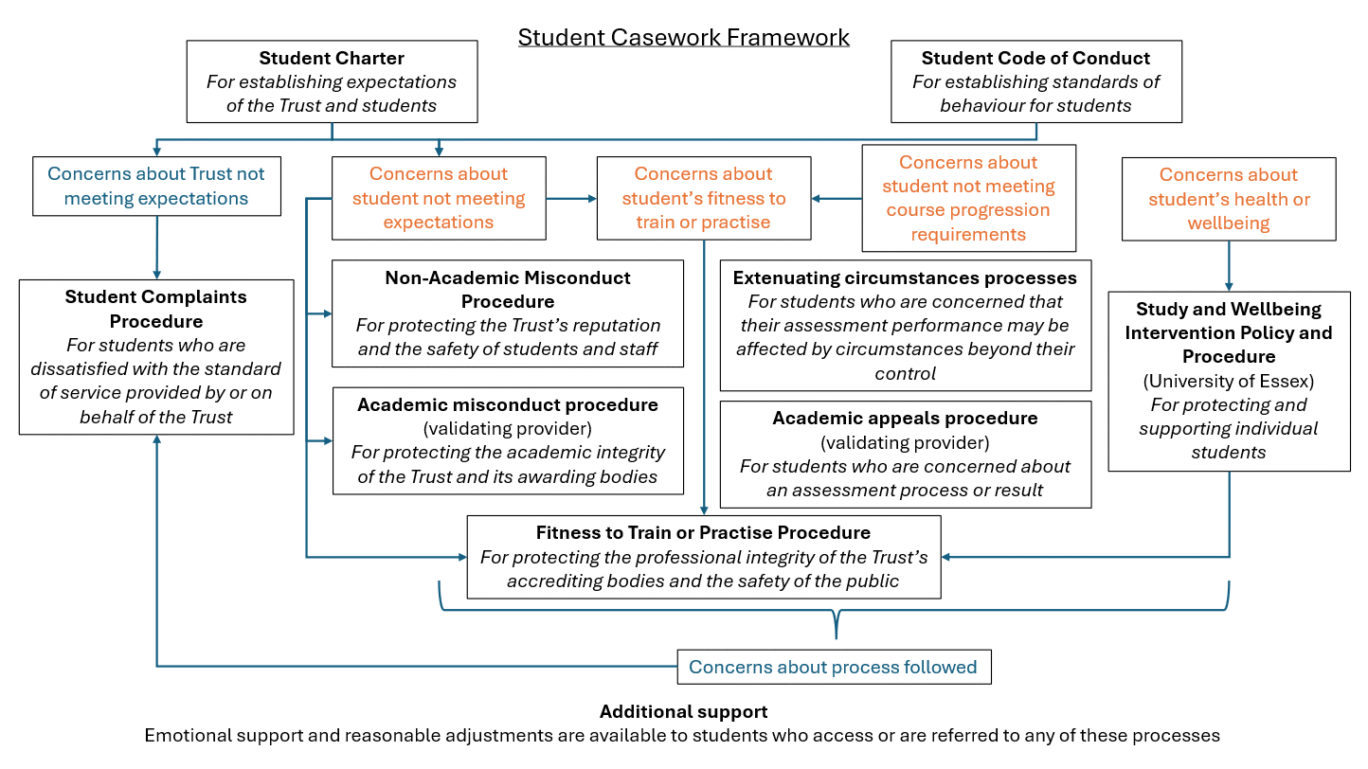
Appendix A: Student Casework Framework
Appendix B: Internal Process Flowchart
Appendix C: Non-Academic Conduct Action Plan