



Using AI appropriately
How to use generative AI appropriately for your studies, teaching or research
Covered in this guide
- General advice before using AI tools
- Using GenAI to help with my learning
- Using AI for research
- Using AI for assessed work
- What things can I do to make sure I use AI appropriately?
- University of Essex courses
Guidance is applicable to all students and to staff involved in teaching or supporting learning at the Tavistock. There is further specific AI guidance for teaching staff.
General advice before using AI tools
Before using Generative AI (GenAI) you should consider:
- when it is appropriate to use a GenAI tool (see below) – there are academic policies on AI use for coursework or research, and you should never try to pass off work written by AI as your own
- GenAI responses are based on historic information and will reflect any biases in the training data
- there are ethical concerns around the use of GenAI
- the instructions you give a GenAI tool (known as prompts) will need to be clear to get the best results, and it can take some experimentation to get something acceptable
- checking the privacy or data settings in any AI tool you use – you may want to turn off any options that let the tool use your work or personal data to train its AI models, as this helps keep your information private and under your control
- GenAI responses are a starting point that will require reviewing – it’s essential that you verify information it produces as you will be responsible if the use of a tool introduces errors to your work.
Remember you should not:
- put private or sensitive information into any AI tools, this includes information about you or any participants in your research or work
- use copyrighted material such as journal articles in GenAI tools
- use GenAI tools as a substitute for searching our library databases and resources – there are limitations in the coverage of the training data
Using GenAI to help with my learning
We encourage you to use GenAI to build an understanding of its strengths and limitations and develop the skills to use AI ethically and effectively.
GenAI should be used as an assistant to augment rather than replace your intellectual and creative thinking. Here are some examples of appropriate ways you can use AI to help you study:
- reviewing an essay plan to help you develop and improve the structure of your assignment
- reorganising and refining your lecture notes
- improve your grammar or your writing style by looking at how it constructs answers to questions
- asking AI for feedback on your written work (but you shouldn’t ask AI to revise or re-write your assessed work)
- asking AI to explain a concept, theory or text that you have had trouble understanding
- discussing a topic to build your understanding of it
- make tasks less challenging if you have additional needs – for example, some AI tools can read text aloud, turn speech into written notes, simplify complex language or provide translations
Never assume the information generated by GenAI is accurate – always review the responses.
Using AI for research
The University of Essex has produced guidance on the use of generative AI for PGR students.
A more general guide on using AI in research is available from the UK Research Integrity Office: Embracing AI with integrity, a practical guide for researchers.
Using AI for assessed work
It is important you do not use AI to generate assessed work and submit it as if it were your own work. You must not copy-and-paste AI-generated text directly into your assessments. All the assessed work you submit for your course must be your own.
Writing your own assignments is the only way in which you will develop the skill of communicating effectively in written form. It is also a key pathway for developing your skills more broadly, including the key abilities of developing, formulating, expressing and testing your own ideas.
You will be cheating yourself if you don’t develop those skills by writing your own assignments – whether with or without assistance from digital tools, including AI. If you are uncertain about your use of AI, talk to your course lead or lecturer.
Declaring your use of AI
There is no requirement to include an explanation or statement in your assessment describing how you have used AI in your learning or assessment preparation.
However, if you use AI for a legitimate reason within your assessment, you must correctly cite and reference it (see below), as you would for any source. Although you can’t use AI to generate text for your assessed work there may be times when AI-generated material is appropriate: for example, a generated image or if your assessment explicitly requires AI use.
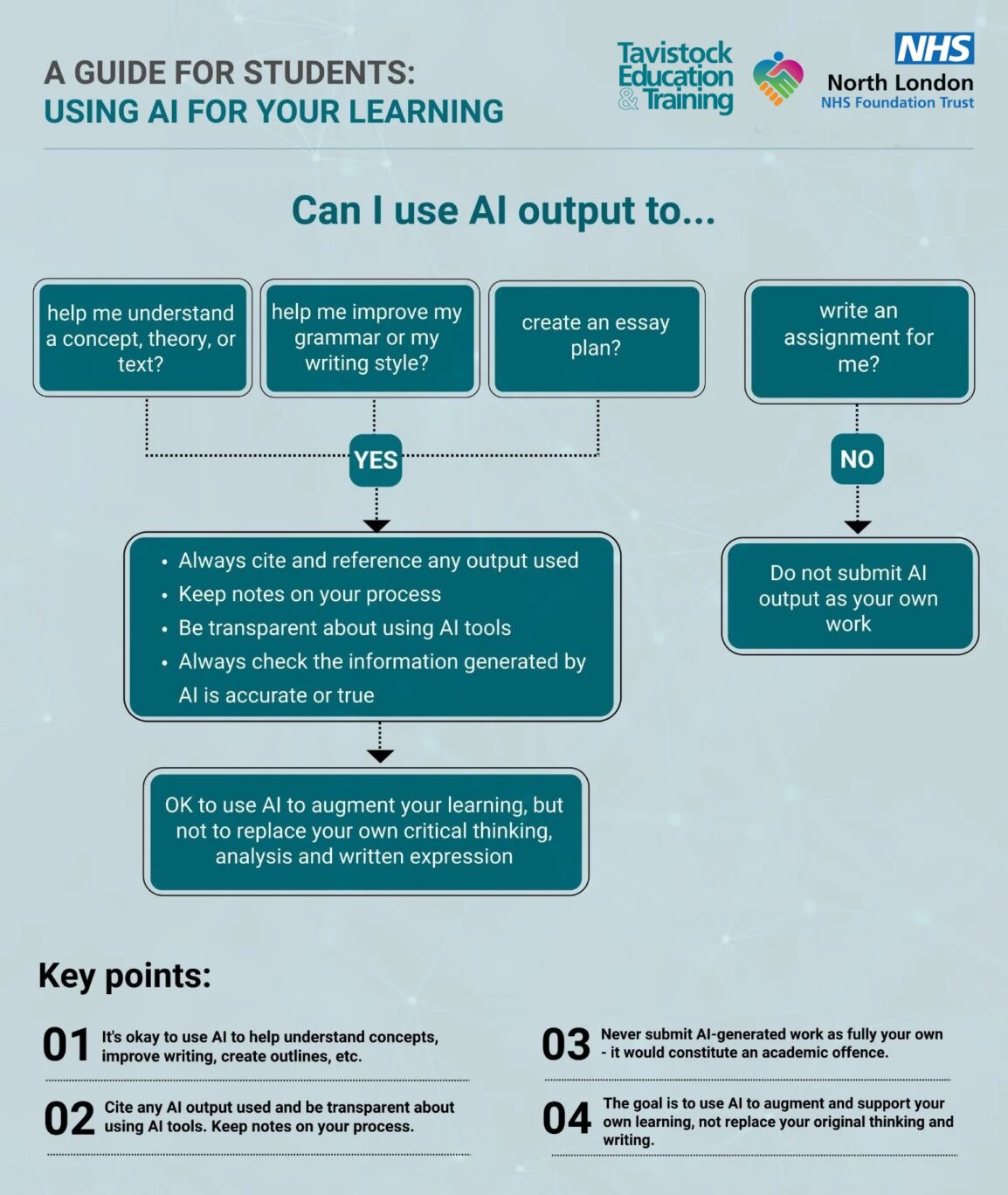
Using AI in your learning
Question: Can I use AI output to…
- Help me understand a concept, theory, or text?
- Yes
- Help me improve my grammar or writing style?
- Yes
- Create an essay plan?
- Yes
If you use AI for any of the purposes above, you should:
- cite and reference any AI-generated output that you use
- keep notes on your process and how you used AI
- be transparent about your use of AI tools
- check that AI-generated information is accurate and reliable
Outcome
It is acceptable to use AI to support and enhance your learning. However, AI should not replace your own critical thinking, analysis, or written expression.
Question: Can I use AI output to write an assignment for me?
No. Do not submit AI-generated content as your own work.
Outcome
Submitting AI-generated work as if it were entirely your own may constitute an academic offence.
Key points
Appropriate uses of AI
- understand concepts, theories, and course materials
- improve grammar, spelling, and writing style
- generate outlines or essay plans
Using AI responsibly
- cite and reference any AI-generated content that influences your work.
- keep records of how you used AI
- be transparent about your use of AI tools
- verify information generated by AI before using it
Academic integrity
You must not submit AI-generated work as entirely your own. Doing so may be considered an academic offence.
Purpose of AI in learning
AI should be used to augment and support your learning, not to replace your own thinking, analysis, decision-making, or written expression.
What things can I do to make sure I use AI appropriately?
- be transparent about which GenAI tools you use and how you have used them in your academic work
- never present AI-generated work as your own in an assignment
- always cite and reference material included in your assignments that is not your own work – use Cite Them Right Online to learn how to cite AI responses in Harvard and APA 7th, as well as other referencing styles
- when you are preparing an assignment, it is a good idea to keep notes that you make along the way and try to keep different versions saved as separate files as your work develops – should you be suspected of committing an academic offence, you will be able to use such notes and archived files to demonstrate how you have constructed the assignment
- never ask AI to generate experimental data which you then submit having purported to have collected it yourself as primary data, either in raw form or after analysis. This is fabrication and counts as academic misconduct
University of Essex courses
The Trust follows the University of Essex procedures regarding academic offences for students on courses that are validated by the University of Essex. If you attempt to pass off AI-generated material as your own work, you will be committing an academic offence.
Under 1.2 of the University of Essex Academic Offences Procedures, the following would constitute an academic offence:
‘False authorship or Contract cheating: Hiring someone else or using artificial intelligence, machine learning, or other automated technology to create written material that you then submit as your own original work.’
Read the full University of Essex academic offences procedure.
About our guidance
Our guidance is adapted from the University of Essex’s artificial intelligence guidance for students.